Ahead, the barrier shimmered—impossibly tall, a towering wall of warped light that flickered under the setting sun like heat off asphalt. It stretched so high it seemed to vanish into the pink-tinted curve of the dome overhead, its surface rippling in restless waves of colour, glassy one second and liquid the next. Standing near it made Celeste’s skin prickle. It felt wrong in a way she could not quite name, like standing too close to the edge of a dream and realising something on the other side was staring back.
And beyond it—
there was nothing they could properly see.
Not a city. Not open land. Not even sky.
Just a shifting mist of darkness, thick and depthless, like ink suspended in water. It swallowed detail completely. The world on the other side had no shape to it, no horizon, no promise that there was even ground waiting beyond the barrier at all.
Above them, the skies were strangely clear despite everything—an open blue bruised only by the faint pink hue cast by the dome that sealed Clawdiff in. Clouds drifted lazily overhead, and fresh air still moved through the open space beneath the barrier’s edge, cool and clean and so normal it almost made the scene worse.
Then a bugbird fluttered through the barrier.
For one hopeful second, it looked as though it had passed safely beyond—
and then it dropped.
Its tiny body vanished straight down into the darkness on the other side, swallowed whole without even a sound.
Celeste felt her stomach tighten.
Before moving closer, she crouched by the car and gently lifted Bonbon back into the seat, tucking the wrap snugly around her small body.
“Stay here for me, sweetheart,” she said softly, brushing a bit of syrup-sticky fur from the panda cub’s cheek. “Stay low and hide while I check out the barrier, alright?”
Bonbon blinked up at her with wide, solemn eyes, then gave a tiny nod.
“Bydda i’n cuddio,” she mumbled around her pacifier.
(I’ll hide.)
From the bonnet, Hughes glanced over and answered without missing a beat, his Welsh rougher but warm.
“Da iawn, bach. Aros yn isel.”
(Good girl, little one. Stay low.)
Bonbon’s face brightened at once. She smiled at him, delighted to hear the language back, and wriggled deeper into the seat like that alone made hiding easier.
Celeste straightened slowly, staring back at the barrier and the black mist beyond it. Her ears lowered.
“Are… are we sure we want to go through that?” she asked quietly.
Ray didn’t even hesitate.
“I’d rather risk that mist than the candy zombies.”
Only then did Celeste step a little away from the noise, folding her arms and gazing at the barrier. “It looks so… unnatural,” she whispered.
Arcade stood beside her, tablet flickering in his paws. His voice was clipped, calculating. “If Ray’s hammer really can destabilise it…”
“Then we hit fast and hard,” Ray finished, leaning casually on her hammer, lollipop now stuck behind her ear.
Mezzo rubbed the scuff on the car’s ruined bumper, sighing. “What if we can’t? I mean, what if we go all around Clawdiff looking for a way out and it just… doesn’t end? We’re just runnin’ in circles.”
Lumina, sitting cross-legged with her shield in her lap, tilted her head. “Looks like… giant glass. But bad glass. Crunchy.”
Skye, beside her, added softly, “It hums wrong. Like… like a fridge about to break.”
The wolf leaned against a cracked signpost, arms folded. His silver fur caught the fading light, his expression measured but stern. “Whatever you’re planning,” he said evenly, “do it soon. That thing doesn’t like hesitation. It watches.”
Celeste froze, heart tightening. “…What thing?” she asked, voice barely above a whisper.
The wolf didn’t answer. He simply lifted his chin, pointing upward.
They all followed his gaze.
High above, wings spread vast and blazing, a phoenix circled in silence. The Syrup Phoenix, Ashsugar. Her feathers burned in molten hues, leaving a faint trail of embers as it wheeled through the sky.
The group’s breath caught, disbelief etched into every face.
“How… how didn’t we notice that?” Celeste murmured, horrified.
The wolf’s lips curled in a faint scoff. “Exactly. That’s why I said I was surprised you’re still alive. That thing’s been shadowing you, watching. And when your friend decided to barrel down the road in that car like a lunatic—” he cut Mezzo a sharp look, “—the horde scattered.”
Mezzo raised both paws. “Oi! Don’t blame me! That was style, that was!”
Arcade scrolled furiously through his device, voice tight. “He’s right. Before your stunt, my readings counted hundreds—possibly thousands—on the streets. Now…” His quills bristled as the numbers updated. “…barely a fraction remain.”
Ray’s eyes narrowed. “They’re not wandering. They’re being pulled back.”
“Coordinated,” Arcade confirmed grimly. “The phoenix. The centipede. Maybe more generals we haven’t seen yet.”
Celeste’s paws tightened at her sides, her voice small but heavy with dread. “Then… they don’t want us dead. Not yet. They’re… studying us.”
The goat didn’t even look up from his wrenchwork. “Or savin’ the feast for later,” he muttered darkly.
Ashsugar wheeled one more time, then vanished behind a bank of clouds—hidden, but not gone.
Silence pressed in on them, heavy as stone.
They weren’t just survivors anymore. They were prey.
Arcade made a sharp, strangled sound beside her.
Celeste turned at once.
He’d gone pale beneath his fur. His pupils were blown wide, glasses slightly skewed, one paw still clutched so tight around his omni-tool his knuckles had gone rigid. His breathing was wrong—too fast, too shallow. Not annoyance. Not sarcasm.
Panic.
“Arcade?” Celeste asked softly.
He didn’t answer her.
Instead, he looked up at C.H.I.P., who was hovering nearby with all the emotional warmth of a smug kitchen appliance.
“Chip,” Arcade said, voice thin and fraying at the edges, “is this real? Is any of this real? Are there really more zombies than we can see?”
C.H.I.P. bobbed once.
“Oh, absolutely,” he said brightly. “You’re only seeing a very small fraction. The rest are hiding underground. They seem to be purposely avoiding you. Probably because you’re weak and have no idea what you’re doing.”
Arcade stared at him.
Then he made the mistake of understanding every word.
“So what you’re saying,” he said, voice climbing higher, “I mean—what you’re saying is if they attacked now, we would be—?”
“Oh, definitely dead,” said C.H.I.P. with cheerful certainty. “Within seconds, most likely. You’d be overwhelmed immediately.”
That did it.
Arcade’s breath hitched so hard it almost sounded painful. He took one step back, then another, quills rising, whole body beginning to shake.
“How do I know you’re real?” he blurted. “How do I know any of what you say is real?”
Without hesitation, C.H.I.P. projected a hologram into the air.
Heat scans bloomed over Clawdiff in layered reds and violent oranges.
The streets they could see were sparse.
Below them—
under roads, tunnels, buildings, drainage lines, rail systems, cellars, collapsed stations—
there were hundreds.
Thousands.
Heat signatures packed beneath the city like a living infection.
Arcade looked up at it.
And broke.
“No,” he said weakly. Then louder: “No, no, no—”
He stumbled back so fast he nearly tripped over the cracked kerb, breath coming in fast, useless little pulls that never seemed to fill his lungs. His eyes darted everywhere at once, as if logic might reassemble itself if he looked hard enough.
“It doesn’t make sense,” he said, voice cracking. “It doesn’t make sense, it doesn’t make sense, there’s too many, there’s too many—”
“Arcade.”
Skye was there before anyone else, stepping in close and lowering himself into Arcade’s line of sight.
“Look at me,” he said quietly.
Arcade didn’t.
His hands were trembling so badly he nearly dropped his omni-tool.
“We are screwed,” he said, half to himself now. “There are too many. There are too many.”
Skye put both hands on Arcade’s forearms, grounding him.
“Breathe,” he said. “Not fast. Slow.”
Arcade shook his head like he physically couldn’t.
“Yes, you can,” Skye said, still calm. “With me.”
He drew in one breath, slow and measured, exaggerated enough to copy.
“Like this.”
Arcade tried.
Failed.
Tried again.
His next breath stuttered, but it came.
“There you go,” Skye murmured. “Again.”
Around them, the others had gone very quiet.
Arcade squeezed his eyes shut, still shaking. “We are screwed,” he whispered. “There are too many.”
For once, C.H.I.P. did not interrupt immediately.
He drifted lower until he hovered at Arcade’s shoulder height, little red-and-blue eyes dimming a fraction.
Then, in a tone still unmistakably his—still dry, still a bit rude, still wrapped in sarcasm like armour—he said,
“Well, yes. Statistically, you are in a catastrophic situation. But you are also catastrophically smart, annoyingly hard to kill, and currently surrounded by people who have not run away from you yet. So perhaps hold off on the complete emotional collapse for, say, five minutes.”
Arcade let out a shaky, broken laugh that sounded a little too close to crying.
C.H.I.P. continued, quieter now.
“You do not have to solve the entire apocalypse this second. You just have to keep breathing long enough to be insufferable about it later.”
That made Skye look up sharply.
He stared at C.H.I.P., then at Arcade.
And suddenly he understood.
The sarcasm. The over-explaining. The sharp little digs that landed exactly where Arcade’s own mind would go when he was scared.
C.H.I.P. wasn’t random.
He sounded like what Arcade thought people thought of him.
A clever little machine shaped like self-criticism, pretending to be a joke.
Skye’s expression softened.
Arcade dragged in another uneven breath, then another, still trembling but no longer spiraling quite so hard.
C.H.I.P. gave a tiny mechanical hum.
“There,” he said, with forced lightness. “See? Minimal screaming. We’re all growing.”
Skye kept one hand steady on Arcade’s arm and said nothing.
But the way he looked at the little robot had changed completely.
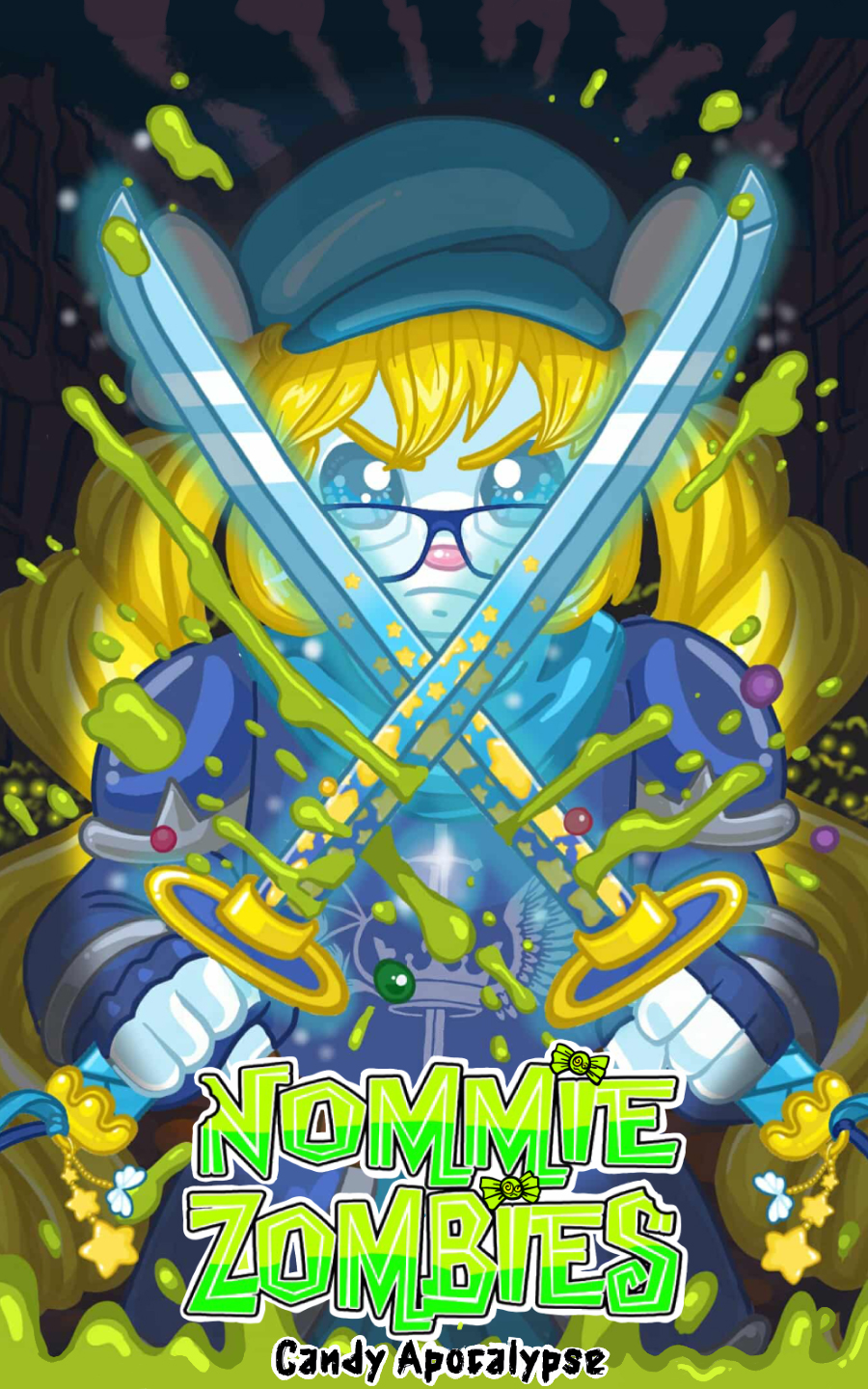
Celeste turned to Ray and Mezzo, her grip tightening on her swords. “Should we run,” she asked breathlessly, “or smash the barrier?”
Ray answered for her at once.
“Smash it.”
Mezzo cracked his knuckles, grin wild. “Finally. Something to break that isn’t a vending machine!”
The silver wolf shot them both a sharp look. “Are you sure that’ll work? We threw a military grenade at that thing and it wouldn’t budge.”
Mezzo turned toward him, all reckless fire and bad judgment. “If we’re quick, we can get out of here.”
He jabbed a thumb toward the barrier.
“We’re so close,” he said, ears flattened but eyes hard. “Meters from being free. I don’t know if it’ll hold—or smash us trying—but we have to try.”
Celeste turned to Lumina, who was already shielding Bonbon on instinct.
“Lumina, pet—stay with Bonbon. Keep her safe. Don’t move unless you must, alright?”
Lumina nodded seriously, shield glowing faintly as Bonbon clutched her stuffed toy and babbled nonsense encouragements.
Celeste turned back just in time to see movement below the street.
Sewer grates rattled.
Then burst open.
Zombies began crawling up from the dark in jerking, syrup-slick waves—arms first, then heads, then bodies dragging themselves onto the pavement with wet, scraping sounds.
Celeste’s stomach dropped.
“You guys do your best,” she said, voice small but steady. “I’ll try and make sure they don’t get to you.”
Ray scoffed, swinging her hammer onto her shoulder. “No promises it won’t blow us sky-high. But if I’m going out, I’m going out swinging.”
The phoenix, Ashsugar, screeched again—a cacophony of warped, sugary cruelty—as it swept overhead. Its molten syrup wings dripped onto the asphalt, sizzling in neon puddles, each drop hissing with dark energy. It laughed—a shrill, knowing cackle—as though amused by their desperation.
Then, without warning, a dozen more zombies burst from hiding.
They poured from alleyways, flipped from rooftops, crawled out of broken vehicles and the split mouths of drains. Their movements were too fluid, too precise.
These weren’t merely undead.
They were being directed.
An ambush.
Celeste’s heart pounded. She reached instinctively for her swords—those strange, unwieldy blades she still didn’t know how to use properly. Her arms felt heavy, untrained.
Why swords? she thought bitterly, backing up. Why not a staff? Or magic—anything but this.
She had always loved magic in games—controlling the field from a distance, healing, support, strategy.
But here?
Everything felt wrong.
As if this world had been built specifically to make her fight in the one way she least understood.
The zombies advanced, closing in on all sides.
Just then, the first one lunged—
straight for the old goat, still hunched over the crumpled car hood with his wrench in hand.
Celeste opened her mouth to scream a warning—
—but the creature froze.
Its limbs locked mid-motion. Its jaw hung open. Its whole body shuddered in place as though the air around it had suddenly thickened into glass.
A shimmer spread around it.
Then a pulse radiated from the old goat’s chest—a deep green light glowing beneath his patched-up vest.
The colour was unmistakable.
He had eaten a candy.
Hughes turned slowly, not panicked in the slightest.
“Thought I felt a tremor,” he muttered, standing up with surprising calm. He brushed his hands off and peered over his glasses. “Guess we’re doin’ this now.”
The trapped zombie cracked like toffee.
Then splintered apart into caramelised dust.
Celeste stared, wide-eyed, her swords trembling in her hands.
“He’s… he’s a hybrid,” she breathed. “He must’ve eaten the candy.”
Her fear tangled with something else now.
Something sharper.
Curiosity.