
1 · The End of the World
Aristotle reached the end of the world on his walk today. He usually tries to reach the end of the world before the hot brightness in the sky retreats below the mountains, with the goal of getting to the other side of the world the following day. To do so feels natural, as if his existence is conditional upon such activity. Doing so suppresses the cloying sensation that the thoughts in his head are not his own.
What is a mountain? Why does that word sit in his head like a pebble wedged in between the parts of his body that he desperately wants to not be called a foot.
Aristotle reached the end of the world. The tall grey peaks erupt from the ground vertically, totally impassable. He cannot look past them; there is nothing past them. He walks right up to the world's walls and rubs his large white tusks against their face. This is good.
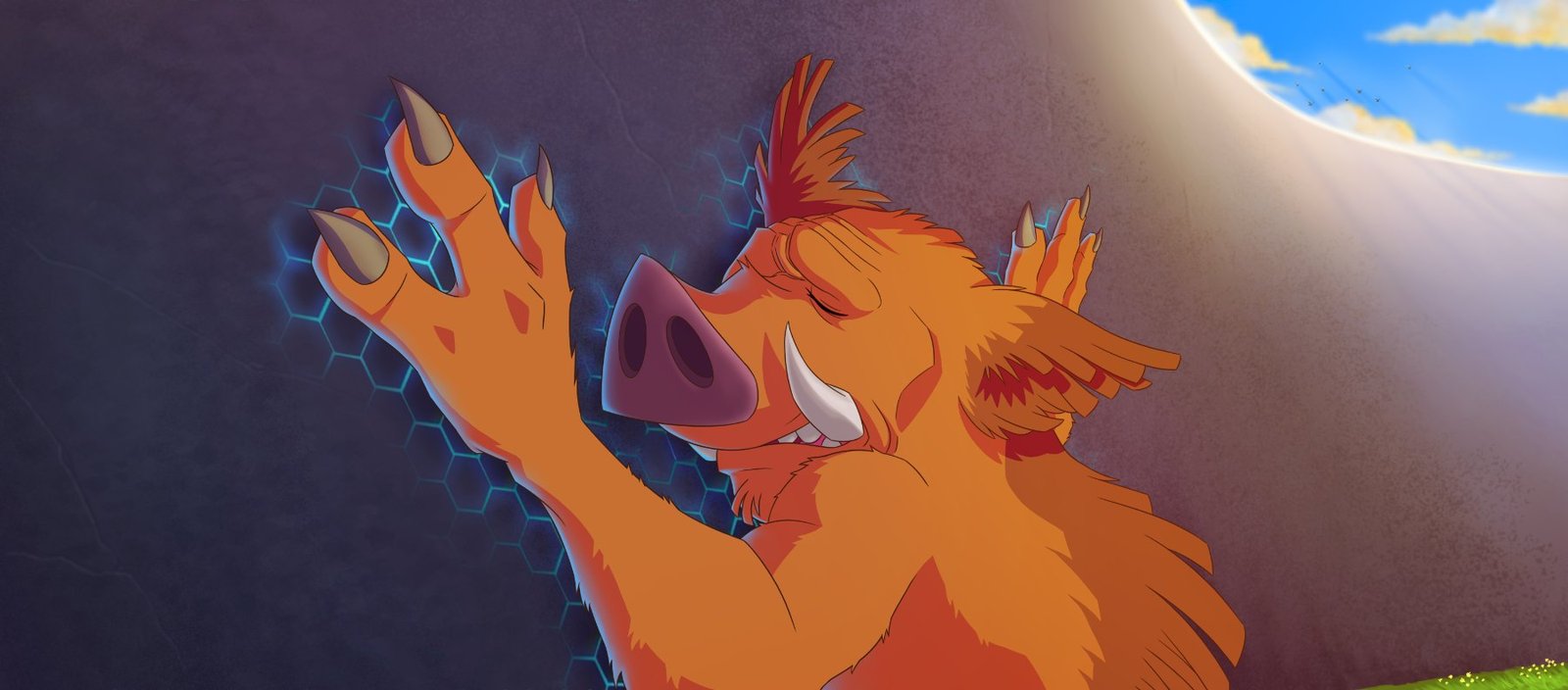
Fig. 01 — The Edge of the World — Aristotle embraces the pen wall, the holographic lattice flickering under his hands · Illustration by Lucas
His ablutions are interrupted by the formation of a scent. Not quite wanting to be interrupted yet, Aristotle outstretches his large hairy arms and embraces the rocky wall of the world. A tear forms in his eye as he gives thanks to the world — a tear of joy for the world's beauty, a tear of sadness because he must say thanks using words that are not his own. Soon the scent coming up from the ground becomes unignorable. His form feels empty. He needs to feed.
Aristotle stops embracing the wall and squats down towards the ground. He pauses before drawing a single long inhale through his nostrils. Every time he does so it creates a war in his mind, and this time is no different. All his words desperately try to withstand the onslaught of information that his nostrils can bring forth. No matter how many times he breathes in, the words remain. His feet are rooted to the ground as he smells the food coming up from the Earth getting ever closer. He goes down onto his hands and knees and sticks his nose into the ground and breathes once more. The food is coming. Hasty for its arrival, Aristotle uses his tusks and snout to begin rooting into the ground, to access that which gives him life. A clot of soil gets stuck in one of his nostrils, causing him to sneeze it out. Using his fingers to clean himself he pauses, crouching to the ground. The food is as close as it usually gets; it is now up to him to reach it. The soil in his snout was unpleasant, and without giving it much thought Aristotle begins to use his hands to dig in the soil. Moving around pebbles and inedible roots, his pace increases as the tantalizing odor beckons. He notes to himself that digging with his hands frees up his nose to smell, allowing him to work more efficiently. Reaching the cache of plump tubers he pulls them from the ground and stacks them into a small pile. Once all of the tubers in the world were removed from the ground he begins eating them, while holding in his heart the hope and the prayer that the next day's harvest will rise from the soil as all others have before it.
Leaning his head against the wall of the world, Aristotle drifts off to sleep while he wonders and gives thanks. Thanks for the soil that gives him food. Thanks to the world for being so kind and gentle to him. The stone wall of the world is cool to the touch, which relaxes and coaxes him into the oblivion of sleep that must be different from the death that he finds a way to fear without yet understanding.
When in sleep he dreams. One day he will be embarrassed by this.
Discuss this chapter